Showing posts with label Sam. Show all posts

Friday, April 21, 2017

Common Variable Immune Deficiency

Sam is our middle child and fits many of the middle child stereotypes.  
  • Family clown
  • Master Negotiator
  • Independent
  • Risk Taker
He is our family's mover and shaker.  If things get boring, count on Sam to stir up some fun, aka trouble and mischief.


He also is constantly on the go.  This boy never stops.  He loves soccer and has great natural talent. He loves the outdoors, science projects, building things, Legos, air soft guns, and anything that allows him to be on the go.  

So a few years ago we were shocked when he told us he was too tired to go to soccer practice.  A few days later he asked to be pulled from a game because he was tired.  Then came the day when he slept, all day.  I mean all day.  No breakfast.  He slept through lunch.  He woke long enough to have a snack and he returned to bed.  Not normal for Sam.  Not normal for any healthy child.
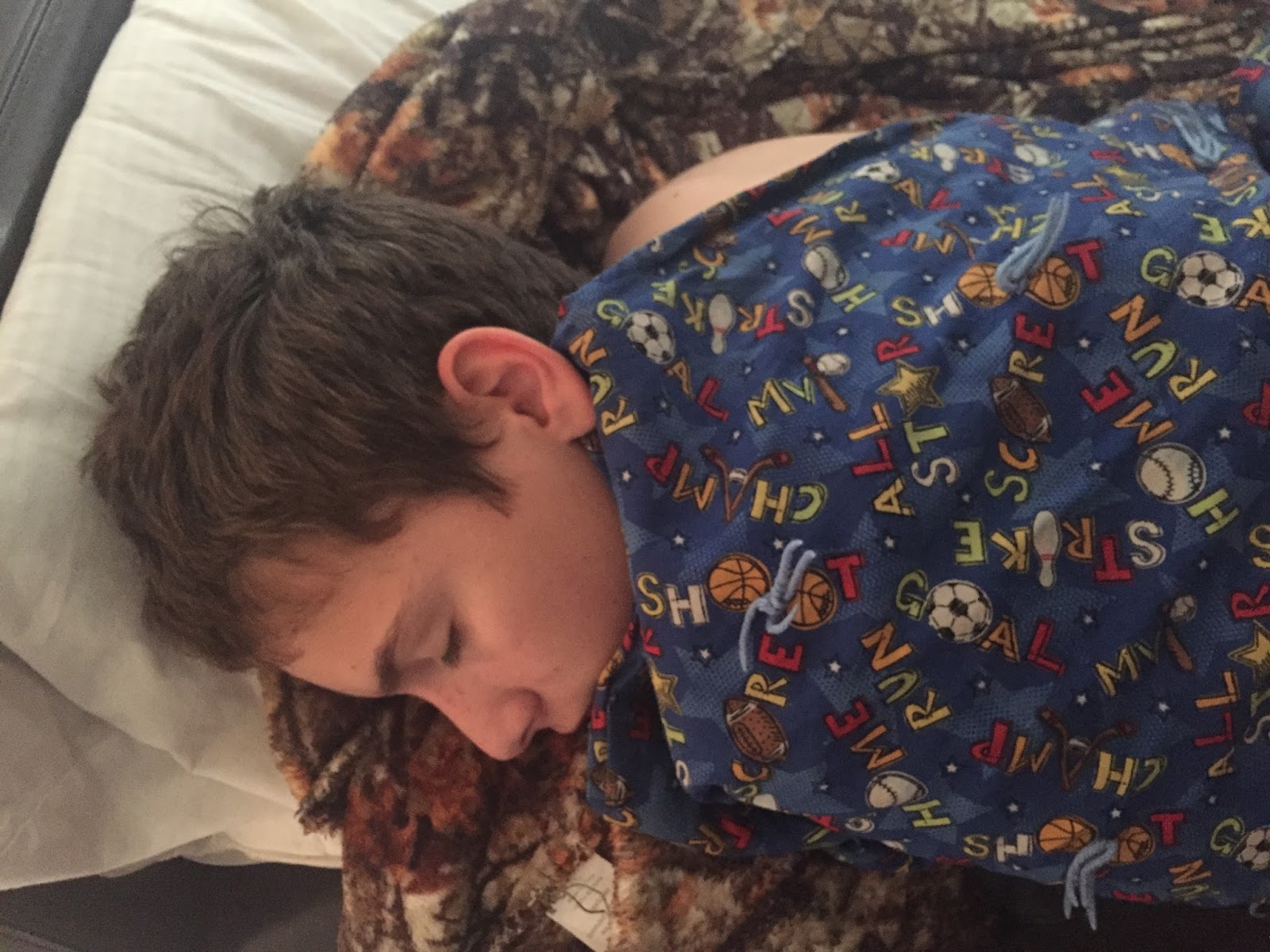
Sam asleep during the day.  A sight we never saw when he was younger.

Off the the doctor's office we went.  We ran a series of blood tests which told us he was recovering from mono. That eased my worry and we allowed him lots of rest and good food.

Sam recovered for a while.  But the cycle started again. During the next 2 years, Sam dropped out of soccer, quit playing with friends after school, had mono twice, and began having migraines.  

We are blessed to have a fabulous pediatrician (who adopted special needs children as well).  He trusted my instincts that something was wrong and continued to test Sam.  The tests came back that Sam's IGG levels were a little low. So our doctor sent us to an immunologist.

After more testing, Sam was diagnosed with Common Variable Immune Deficiency.  CVID is a disorder that impairs the immune system which means Sam is highly susceptible to infections.

Treatments include a medication called Hizentra.  IGG levels had to drop pretty low for the insurance company to approve the treatment.  And the medication is expensive enough (thousands a month), that we needed insurance.  

So we waited 1 year for his levels to drop and I worried about his health.

Finally, we started infusions of Hizentra about 6 months ago.  I get to administer them to Sam at home which includes placing 4 small needles in his body so the medication can slowly be absorbed. Treatments usually take 3-4 hours, including 1 hour of numbing cream before placing the needles. The treatments are painful and sometimes cause severe headaches.

All the medication, supplies and equipment can be overwhelming.
Preparing for the injections with the numbing cream.  A must!!!!

Sam prefers leg sites, although we prep other areas as well.  Just in case!
Injection sites leave large bumps for a day or two. 

Our first infusion required six sites so the body could get used to the medication.

Last week I had placed 2 needles, both of which were painful when Sam refused to continue.

Sam-Take them out!  I'm done. (Tears streaming down his face)

Me-I can't Sam.  I have already drawn the medication.  

Sam-Nope, I'm done!  Get them OUT.  I am going to rip them out.

After about 10 minutes of this I persuaded him to put Lidocaine back on the spots we were planning on using.  20 minutes later I was able to place the needles and continue with the injection.

Although we were able to continue, I had to leave the room afterward and go have a quiet cry in my room.

Sam doesn't like the injections.  He hates the headaches he gets.  He feels like he has enough problems from being exposed to meth during pregnancy.  It's not fair.  And I have to agree that's its not fair.  

I reached out to a friend who's daughter has similar issues.  She was able to give some good advice and told us about a conference for families dealing with this issue.  I want to go.  I want Sam to see he isn't the only one. That others understand what he is experiencing.

Hope is difficult but not impossible right now.  I am grateful for new medications that are working to save his life.  We are blessed! I would love to hear what those of you with a chronically ill child do to help buoy them up.  

We have hope.


Thursday, March 30, 2017

Reframing


Sam is our middle child and our family clown and we adore him.  When I first arrived at the hospital to pick him up, a social worker brought me into another room to talk about certain issues.  She made sure I knew that the meconium had tested positive for Methamphetamines and we discussed various effects that might have on Sam.

Then she paused and said she needed to tell me about another problem Sam had.  She told me that Sam had facial palsy that prevented him from moving one side of his mouth and interfered with his closing and opening one eye.  Calmly and quietly she explained that when he cried, one eye would remain open while the other was squeezed shut.  She hesitated and I grew concerned about how this would effect him and what we would do about it. 

She continued, "When he cries, he is . . . he is just SO CUTE!"  Her positive response to something I had started to worry about, surprised me and as she laughed and described more about him I started to see things differently.

Her comments of: "He is just all our favorite"  "The nurses adore him"  "We call him our One-Eyed Jack" changed my attitude about Sam's palsy.  What she was able to do for me was "Reframe" my view and opinion about the palsy.  Instead of it being a negative, it turned into a unique character trait that made him irresistible.


The day we picked up Sam from the hospital and the AMAZING social worker in the background. She taught me a vital skill in dealing with the special needs of my children.


During our journey with multiple special needs and chronic illness, we have used this technique of reframing many times.  What at first seems insurmountable, can be overcome with a perspective change.

Sometimes when we focus too closely on a problem it becomes all we see, blocking anything else from our view.  But if we can image ourselves setting the problem down, and viewing it from another angle, new perspectives appear.

For example, if I were to hold a large rock in front of my eyes, it is hard to see around it.  It would be a stumbling block for me when trying to do anything else.  Yet if I can set that rock on the ground and view it from above, I begin to see it as just one part of my path and not an insurmountable part of my path.

Let me explain this another way again.   Our son Levi has autism and he has always been large for his age.  From a young age, he has had behaviors that are difficult to manage at times and his large size added to that difficulty.  To keep him from acting out on a sibling I would often step in between him and the sibling and gently restrain him.  This became more and more difficult the larger he became. During prayer one day, I was "discussing" (another word for venting) about this problem to God.  I was getting hurt, I couldn't carry him anymore away from the others and it was bothering me.  My complaint was that if Levi was going to be aggressive and violent, couldn't he at least be the smallest of the children?

A few weeks later I was talking with a friend about bullying at school and I realized that I didn't worry about people physically bullying Levi.  Because he was so large and tall, he wasn't the target of people who would physically confront him.  All of a sudden my perspective changed!  I realized that his size wasn't a hindrance at all.  I was grateful he was large enough to deter any bullies at school. Who would pick on a 6 foot 200 pound 7th grader?  No one!  That is one issue we have never had to deal with for Levi.  This perspective shift didn't change the fact that at home I still would have to restrain a 200 pound child at times, but it changed my attitude about it.  I became grateful for his size and was glad he was so large.

Sam has learned some control over his facial muscles, but he will always sleep with one eye slightly open and his smile will always be crooked.  But instead of seeing that as a problem, it makes Sam, SAM!  I can't imagine him without his "devil may care" crooked smile and mischievous look.  It has become his trademark.


Who can resist that smile when it asks for a cookie or has been teasing his sister?  (Okay, I really can but it is hard.)  

Reframing our attitudes about a diagnosis, behavior, or other problem isn't easy.  And I'm not suggesting we become a Pollyanna, totally oblivious to the facts or difficulties we are facing.  What I am suggesting is that we need a positive outlook in order to move forward.  Negative thoughts and emotions freeze us and we lose our energy, our problem solving abilities, and our hope.  Reframing and looking at the problem from a new perspective creates positive energy, helps us problem solve, and gives us hope.  And if our children are to see their "disabilities" as "abilities" we must model that for them.